How Agricultural Drones Are Changing the Way We Farm
From Above: A New Perspective on the Fields
When I first watched a drone lift off over a wheat field, I expected a novelty. What I saw instead was a working tool, one that turned a muddy, time-consuming scouting job into a twenty-minute flight. The machine hummed along, its multispectral sensors gathering data that would have taken me days to collect on foot. That experience changed how I think about modern farming, and it is why I believe agricultural drones are no longer a futuristic idea but a practical part of the toolbox.
The shift has been gradual but steady. Ten years ago, most farmers saw drones as expensive toys. Today, the same growers use them for field mapping, crop health monitoring, and even for spreading seeds and fertiliser. The technology has matured, and so has its reputation. What was once a niche interest is now a mainstream method, and the results speak for themselves in yield data and input savings.
Seeing the Invisible: Remote Sensing and Crop Health
One of the first jobs drones took over was scouting. Walking a field, pulling leaves, checking for pests, all of that still happens, but drones do it faster and with more precision. Aerial imaging from a drone equipped with multispectral sensors can show stress in a crop before the human eye notices anything wrong. A patch of yellowing leaves might look uniform from the ground, but from above, the sensor picks up subtle changes in reflectance that indicate a nitrogen deficiency or an early sign of disease.
This is where precision agriculture comes in. Instead of treating an entire field the same way, you can target the areas that actually need attention. For example, a friend of mine in Norfolk uses drone imagery to map variability in his potato crop. He then adjusts his fertiliser application field by field, sometimes even within a single field, using variable rate application. The result is less waste, healthier plants, and a better bottom line.
Field mapping is another quiet win. A drone can create a high-resolution map of the field in minutes, showing drainage patterns, soil variations, and even compaction zones. That information, combined with GPS guidance, helps you plan planting and irrigation with far more accuracy. It is not about replacing the farmer's eye; it is about giving that eye a wider view.
Spreading and Spraying: The Workhorses of the Sky
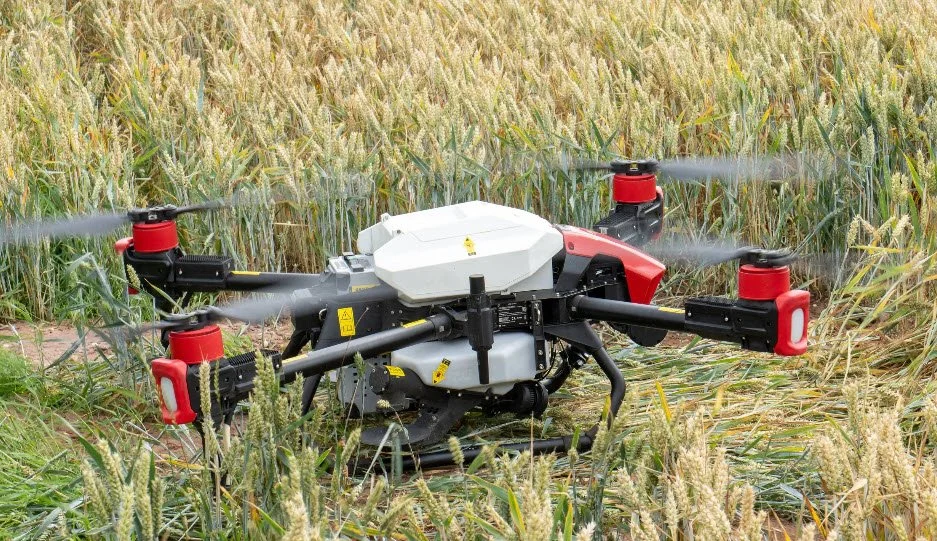
While imaging and mapping are valuable, the real muscle of agricultural drones shows in spreading and spraying. Crop spraying from the air is not new, but it has traditionally meant large, expensive aircraft or helicopters. Drones like the DJI Agras series and models from XAG have changed that equation. These machines carry tanks for liquid or hoppers for granules, and they can cover ground quickly with a level of control that ground rigs struggle to match.
Drone spraying is especially useful in fields that are too wet for tractors, too small for a full-size plane, or too hilly for comfortable ground work. I have seen a drone spray a steep vineyard that would have been dangerous to treat with a wheeled sprayer. The operator stood on a flat spot, the drone did the climbing, and the crop got its plant protection without anyone risking a rollover.
Seed spreading is another growing use. Instead of broadcasting seed by hand or with a spinning disc that scatters it unevenly, a drone can drop seed in precise rows or clumps. This works for cover crops, pasture renovation, and even rice seeding in some regions. The accuracy means you use less seed, and the establishment rate is often better because the seed lands where you intended.
Defoliation, which is common in cotton farming, is also done with drones. The ability to apply a targeted spray to speed up leaf drop before harvest saves time and reduces chemical use. It is a delicate job, and the drone's fine control makes it possible to hit exactly the right rate.
The Practical Side: What to Consider Before You Buy
If you are thinking about bringing agricultural drones onto your farm, there are a few things worth weighing up. The first is regulation. In the UK, you need to follow CAA rules, and commercial work requires a specific permission. That is not a reason to avoid the technology, but it is a reason to plan. The second is training. Flying a drone in a field sounds simple, but doing it safely and efficiently takes practice. A crash in a wheat field is not just a broken machine; it is a delay in your operation.
Battery life is another factor. Most drones fly for twenty to thirty minutes per charge, so you need spare batteries and a charging plan if you have a large area to cover. It is not a dealbreaker, but it does change how you schedule the day. The good news is that the newer models, especially from DJI Agras and XAG, have made big strides in payload capacity and endurance, so the window of workable time is expanding.
Then there is the question of data. A drone is only as good as the software that turns its images into decisions. You will need a platform to store, analyse, and act on the data, and that adds a subscription cost. But when you see the savings in fertiliser and agrochemicals, the numbers often work out.
Working with a Service Provider vs. Going It Alone
Not every farm needs to own its own drone. Hiring a service provider can make sense, especially if you only need a few flights a year. A good provider brings the machine, the pilot, the insurance, and the data processing. They also bring experience, which matters when you are trying to diagnose a problem from an image or plan a variable rate application.
There is also the maintenance side. Drones need regular checks, firmware updates, and occasionally a repair. If you are busy with livestock or harvest, the last thing you want is to be soldering a motor at midnight. A service provider handles that, so you stay focused on the farm.
On the other hand, if you have a large operation and you use drones weekly, owning one can be more cost-effective. The key is to do the math and to start small. Rent or hire first, learn what the data actually tells you, and then decide if the investment is worth it.
The Tech Curve: What the Latest Machines Offer
The hardware is improving quickly. The DJI Agras line, for instance, now includes models with radar and vision systems that let the drone fly close to the canopy without hitting obstacles. That is a big deal for orchard work, where branches and wires are a constant hazard. XAG has also pushed the envelope with its own sprayers and spreaders, adding features like RTK positioning for centimetre-level accuracy.
SenseFly's eBee, though a fixed-wing design rather than a multirotor, is another tool in the same ecosystem. It is more about aerial imaging than spraying, but it shows how the field is diversifying. Some farms use a multirotor for spraying and a fixed-wing for large-area mapping. The two complement each other well.
What excites me most is the integration of all this data. When you combine field mapping, crop health monitoring, and yield data from previous seasons, you get a picture that helps you decide not just what to do this week, but what to plant next year. That is the real promise of precision agriculture: not a single gadget, but a system that informs every decision.
Is It Worth It? A Farmer's Bottom Line
I have talked to growers who are sceptical, and I get it. A drone is another piece of equipment to learn, another battery to charge, another thing that can break. But the ones who have adopted the technology rarely go back. They see the savings in inputs, the improved timing of applications, and the reduced risk to workers who no longer have to walk through a freshly sprayed field or ride a tractor over wet ground.
There is also an environmental angle. With agricultural drones, you can apply agrochemicals and fertiliser only where they are needed, which means less runoff and less waste. That matters as regulations tighten and consumers pay more attention to how food is grown.
I remember a conversation with a farmer in Lincolnshire who used a drone to spot a drainage problem in a field that had been underperforming for years. He fixed the drain, and the next season the yield jumped by twenty percent. That was not the drone's doing directly, but it would have taken him another season to find the issue without the aerial view. That is the quiet power of these machines: they see what we cannot, and they help us act on it.
As the technology matures, I expect agricultural drones to become as common as a tractor in the shed. The prices are coming down, the software is getting easier, and the results are harder to ignore. Whether you are spreading seed on a cover crop, spraying for a late-season pest, or just mapping a field for next year's plan, the view from above is becoming an essential part of farming. It is not about replacing the farmer's intuition; it is about giving it wings.